
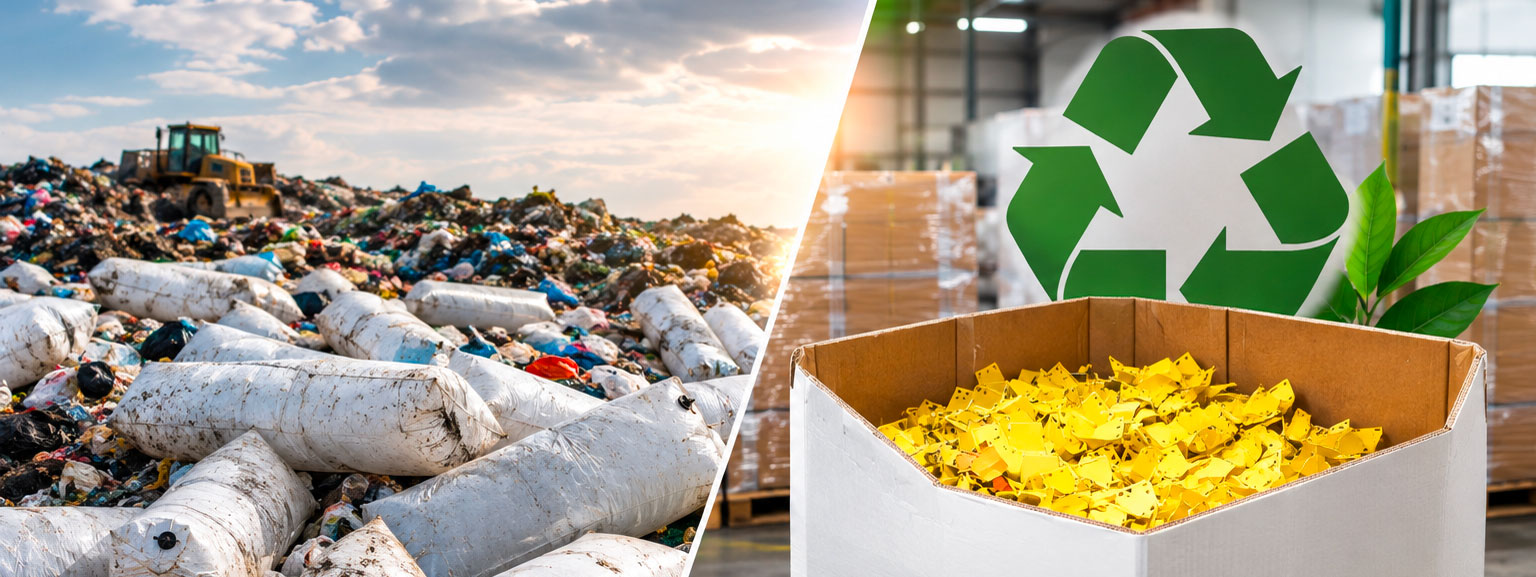
Dunnage airbags are one of the most widely used load securement materials in enclosed trailer shipping. They are also single-use plastic products that generate disposal cost, landfill waste, and growing pressure from retailers and regulators who are actively tracking packaging and dunnage waste across their supply chains. For operations looking for a load securement option that actually eliminates pallet movement, not just reduces it, the alternatives are not all equal. This article evaluates what is available and what the data shows.
Why Operations Are Looking for Airbag Alternatives
The pressure to replace single-use plastic dunnage is coming from multiple directions simultaneously.
Retailer sustainability mandates. Major retailers and club wholesalers have made waste reduction a stated priority across all vendor partners. Dunnage arriving with inbound loads contributes to the disposal burden at receiving facilities, which retailers track and measure. Suppliers who reduce or eliminate plastic dunnage from their inbound loads align with those priorities and improve their vendor standing.
Regulatory pressure. California’s SB 54 and similar legislation in other states are increasing the cost and complexity of single-use plastic packaging and materials. Operations that rely heavily on plastic airbags face growing exposure as these regulations expand.
Disposal cost. A major club wholesaler depot receiving 30,000 inbound loads per month was spending $83,333 per month on dunnage disposal. That cost belongs to the receiving facility, not the shipper. But it affects the vendor relationship and increasingly shows up in sustainability conversations between shippers and their retail partners.
Internal ESG commitments. Many CPG manufacturers and distributors have made public commitments to reduce single-use plastics across their supply chains. Dunnage airbags are a visible and quantifiable target for those commitments.
Common Alternatives to Dunnage Airbags
Cardboard void fill. Corrugated cardboard sheets placed between pallets or stacked loads to reduce movement. Lower upfront cost than airbags but compresses under load, inconsistent in performance, and generates significant cardboard disposal volume at receiving facilities. Not a sustainability improvement over airbags when disposal burden and carbon footprint of cardboard production are considered.
Reusable airbags. Airbags designed for multiple uses rather than single use. Reduces per-load material cost over time but requires a return logistics process and quality inspection between uses. Operationally complex at high volume. Still plastic and still generates disposal cost when bags reach end of life.
Foam and paper void fill. Kraft paper and foam products used to fill gaps between pallets. Better recyclability than plastic airbags in some configurations but still generates disposal volume and requires installation and removal labor on every load.
Load bars and strapping. Steel or aluminum bars placed horizontally across the trailer interior. Strong bracing for certain load configurations but does not address pallet-to-pallet void space, requires tools and labor to install and remove, and generates no recycling value at end of use.
Steel cargo restraint devices. Devices made from recycled steel that install at the base of pallet rows to physically prevent pallets from walking in transit. No inflation required, no tools, no consumables, and no disposal burden at the receiving end. At end of use the devices are collected and recycled as scrap steel, generating a credit rather than a disposal cost.
What the Data Shows About Steel Devices as an Airbag Alternative
The data from operations that have transitioned from airbags to steel cargo restraint devices is consistent across multiple case studies.
One manufacturer eliminated 250,000 lbs of dunnage annually from inbound trailers to a major club wholesaler depot network after switching from airbags and wooden planks to KICK STOPS. Unload time dropped by 30 minutes per trailer. Disposal burden at the receiving depot went to zero.
A 2,000+ shipment pilot at another operation produced one returned shipment across the entire pilot, a 99.95% success rate. The single failure was attributed to improper device application, not device failure.
One depot receiving 30,000 loads per month eliminated $83,333 in monthly disposal costs and began generating $14,400 per month in scrap steel recycling credit after transitioning inbound loads to steel devices, a net monthly benefit of $97,733.
The sustainability case is equally strong. A steel cargo restraint device made from 100% US recycled steel and recycled at end of use operates as a closed-loop material system. It enters the supply chain as recycled steel and exits as scrap steel. No landfill burden. No plastic waste. A credit instead of a disposal invoice.
How to Evaluate Airbag Alternatives for Your Operation
Evaluating airbag alternatives requires looking beyond the per-unit material cost to the full cost picture across materials, labor, disposal, and damage rates.
Ask these questions for each alternative you consider:
Does it eliminate void space or fill it? Void fill treats the symptom. Physical restraint eliminates the cause.
What does it leave at the receiving end? Any material that arrives with the load and has to be removed, processed, and disposed of generates cost for the receiving facility regardless of how sustainable the material is described as being.
What is the recycling or end-of-life value? Single-use materials with no recycling value generate disposal cost. Recyclable steel generates scrap credit.
Does it require tools, inflation, or special training? The simpler the installation process, the more consistent the performance across shifts and operators.
What do your receiving partners say about it? The facility absorbing your dunnage disposal burden has a perspective on your current system that most shippers never ask for.
Key Takeaways
Dunnage airbags are single-use plastic products that generate disposal cost, landfill waste, and growing compliance pressure from retailers and regulators.
Common alternatives including cardboard, reusable airbags, and foam void fill reduce but do not eliminate disposal burden and do not provide recycling value at end of use.
Steel cargo restraint devices made from recycled steel provide a closed-loop alternative to plastic airbags, eliminating disposal burden and generating scrap recycling credit at end of use.
Operations that have transitioned from airbags to steel devices report 99.95% load success rates across 2,000+ shipment pilots, elimination of 250,000 lbs of annual dunnage, and net monthly benefits of $97,733 at high-volume depot locations.
Evaluating airbag alternatives requires comparing the full cost picture across materials, labor, disposal, damage rates, and end-of-life value, not just the per-unit material cost.
Frequently Asked Questions
What load securement option best prevents pallet movement in a trailer?
A steel cargo restraint device prevents pallet movement more completely than airbags, straps, or load bars because it eliminates the void space between pallets entirely rather than relying on pressure or tension that can loosen in transit. Airbags lose pressure with temperature and elevation changes. Straps and load bars address bracing but don’t close the gaps between individual pallets. A steel device closes that gap at the source.
What are the most sustainable alternatives to dunnage airbags?
The most sustainable alternative to dunnage airbags is a steel cargo restraint device made from recycled steel. Unlike plastic airbags and most void-fill materials, steel devices are fully recyclable at end of use and generate a scrap credit rather than a disposal cost. They operate as a closed-loop material with no landfill burden.
Do steel cargo restraint devices work as well as airbags?
Based on pilot data, yes. A 2,000+ shipment pilot using steel cargo restraint devices produced a 99.95% success rate. Airbag performance varies with inflation pressure and correct placement. Steel device performance is consistent regardless of operator when correctly applied.
How do you reduce single-use plastic dunnage in your supply chain?
The most direct path is to replace plastic airbags with a non-plastic load securement method. Steel cargo restraint devices eliminate plastic dunnage entirely from the loads they secure. One manufacturer eliminated 250,000 lbs of annual dunnage from inbound trailers after making this transition.
What do retailers require regarding dunnage and packaging waste?
Major retailers including large club wholesalers have made waste reduction a stated priority across all vendor partners. They track dunnage and packaging waste arriving with inbound loads as part of their sustainability programs. Suppliers who reduce or eliminate plastic dunnage align with those priorities and can improve their vendor standing and scorecard performance.
What happens to steel cargo restraint devices at end of use?
KICK STOPS devices are designed and priced for single use and are collected at end of use for scrap steel recycling. They are made from 100% US recycled steel and return to the recycling stream at end of life. At 30,000 loads per month a depot generates approximately 120,000 lbs of recyclable steel monthly, worth approximately $14,400 at current scrap rates.
Want to evaluate steel cargo restraint devices as an alternative to airbags for your specific operation? We partner with each site to track sustainability and cost savings data specific to your load volume and lane mix. Request a cost analysis
KICK STOPS: The most cost-effective, time-saving, and sustainable freight securement system in the industry.