
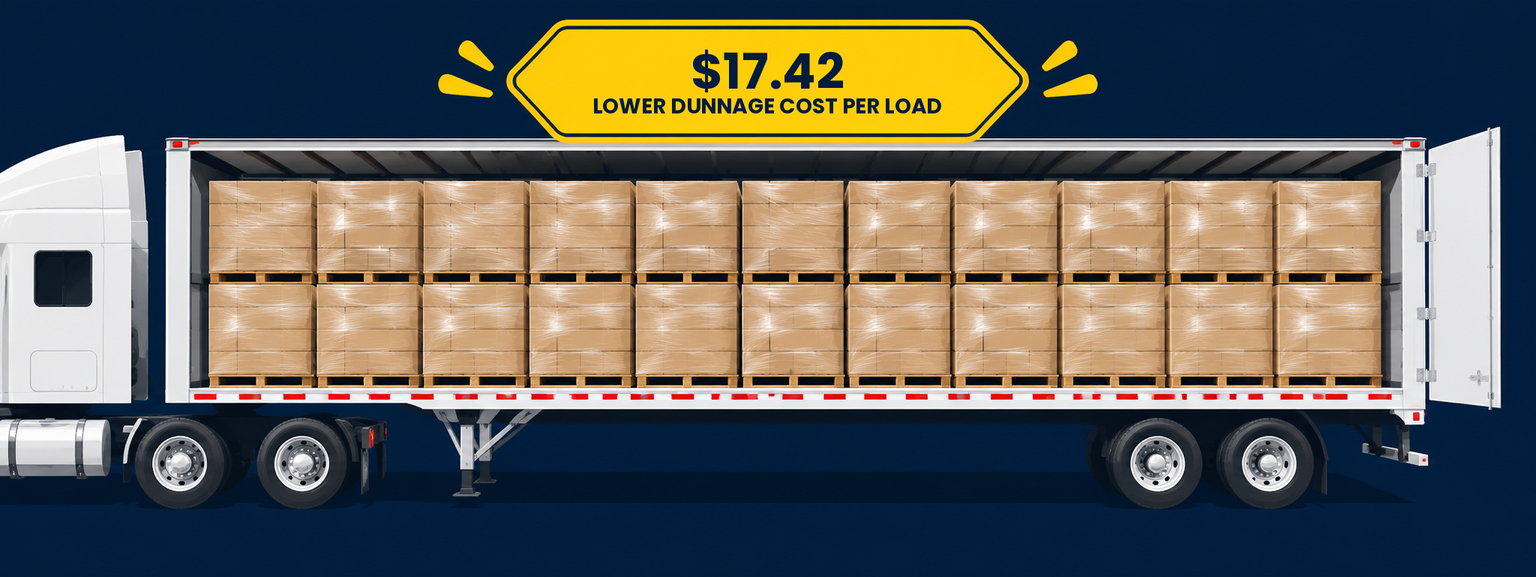
Reducing dunnage costs per trailer is one of the highest-leverage cost reduction opportunities in distribution operations because the savings compound on every load, every day, across every facility in a network. Most operations focus on negotiating better prices for their current dunnage materials. The faster path is reducing how much dunnage each load requires. This case study documents what that looks like at a mid-size facility running 40 loads per day.
Why Dunnage Costs Per Trailer Are Higher Than Most Operations Realize
The dunnage cost per trailer that appears on a purchasing report is only one component of the true cost. The full per-trailer dunnage cost includes materials, labor to install and remove them, and disposal costs at the receiving end.
Most operations track only the materials. The other two costs are real but distributed across different budget lines and different departments, which is why they rarely get added together.
At the facility in this case study, the full per-trailer cost breakdown before switching looked like this:
Average dunnage material cost per load: $29.82 Average load time with dunnage: 1 hour 45 minutes Labor cost allocated to dunnage installation per load: built into hourly dock labor Total daily cost of dunnage and dunnage-related labor: $2,592.80 Total annual cost at a single facility: over $946,000
That annual number does not include damage claims, rework costs, or the disposal burden absorbed by receiving facilities. When those are added, the true annual cost of dunnage per facility regularly exceeds $1 million.
How Much Dunnage Costs Per Trailer Can Be Reduced
After transitioning to KICK STOPS, the same facility tracked their new per-trailer metrics.
Average dunnage cost per load with KICK STOPS: $12.40 Average load time with KICK STOPS: 1 hour 25 minutes Daily savings in dunnage and labor costs: $963.47 Annual savings at a single facility: $347,194.85
The dunnage material cost per load dropped from $29.82 to $12.40, a 48% reduction. Load time dropped by 20 minutes per trailer. And the daily cost of running the dock dropped by nearly $1,000.
Across a 12-facility network running similar volumes, those per-trailer savings scaled to $4.1 million in annual savings.
The Per-Trailer Math That Changes the Business Case
The 48% reduction in dunnage cost per load is significant. But the more compelling number for decision makers building an internal business case is the combined per-trailer impact across all cost categories.
At $29.82 in materials, 20 additional minutes of labor per load at $20 per hour, and the disposal burden absorbed by receiving facilities, the true cost of traditional dunnage per trailer at this facility was significantly higher than the purchasing line item suggested.
At $12.40 in materials, 20 fewer minutes of labor per load, and zero disposal burden at the receiving end, the true cost of KICK STOPS per trailer is lower on every dimension simultaneously.
That is not an incremental improvement. That is a system change that produces savings in materials, labor, and operational efficiency at the same time.
How to Reduce Dunnage Costs Per Trailer at Your Facility
Reducing dunnage costs per trailer requires looking at all three cost components rather than optimizing only the materials line.
Start by calculating your true per-trailer dunnage cost. Pull 12 months of dunnage purchases and divide by total loads. Time your dunnage installation and removal on a representative load and multiply by your average dock wage and annual load volume. Ask your receiving partners what they spend on disposing of the dunnage you send them. Add those three numbers together.
The total is almost always larger than the materials line suggests. And the gap between your true per-trailer dunnage cost and the cost of a physical restraint device is almost always larger than operations expect before they run the calculation.
The fastest path to reducing dunnage costs per trailer is reducing the amount of dunnage each load requires. The most effective way to do that is to address the root cause of dunnage use: void space between pallets and between the load and the trailer walls. When void space is eliminated through proper load patterns and physical floor restraint, dunnage requirements drop dramatically or disappear entirely.
Key Takeaways
The true dunnage cost per trailer includes materials, labor, and disposal costs that are rarely tracked as a single number. Most operations are managing only the materials component.
Transitioning from traditional void-fill dunnage to a steel cargo restraint device reduced dunnage cost per load from $29.82 to $12.40, a 48% reduction in materials alone.
Load time dropped by 20 minutes per trailer after the transition, producing additional labor savings of approximately $6.67 per load at a $20 per hour wage rate.
Combined dunnage and labor savings at a single mid-size facility running 40 loads per day reached $347,194.85 annually.
Across a 12-facility network, per-trailer savings scaled to $4.1 million in annual dunnage and labor cost reduction.
Frequently Asked Questions
What is the average dunnage cost per trailer?
Industry average for facilities using traditional void-fill dunnage including airbags, cardboard, and wooden blocking runs $29 to $33 per trailer load in materials alone. At 40 loads per day that is over $429,000 per year in materials at a single facility before labor and disposal costs are added.
How much can you reduce dunnage costs per trailer by switching to a steel device?
Based on facility data, switching from traditional dunnage averaging $29.82 per load to KICK STOPS at $12.40 per load produces a 48% reduction in per-trailer dunnage material cost. At 40 loads per day that is $696.80 in daily material savings.
What is the total annual savings from reducing dunnage costs per trailer?
At a single mid-size facility running 40 loads per day, combined dunnage material and labor savings after switching to KICK STOPS reached $347,194.85 annually. Across a 12-facility network that scales to $4.1 million per year.
How do you calculate your true dunnage cost per trailer?
True dunnage cost per trailer is calculated across three components: materials cost divided by total loads, labor cost for installation and removal multiplied by wage rate and annual load volume, and disposal cost at receiving facilities. Adding all three produces the actual per-trailer cost, which is almost always higher than the materials line alone suggests.
Does reducing dunnage per trailer affect load stability?
When dunnage is replaced by a physical restraint device that anchors pallets to the trailer floor and void space is eliminated through proper load patterns, load stability improves. Dunnage fills gaps but does not anchor pallets to the floor. A steel restraint device provides direct floor contact and pallet anchoring, which is a more reliable securement method at a lower cost per load.
Want to calculate your true dunnage cost per trailer and what reducing it would mean for your operation? We partner with each site to track cost savings data specific to your load volume and current dunnage spend. Request a cost analysis
KICK STOPS: The most cost-effective, time-saving, and sustainable freight securement system in the industry.