
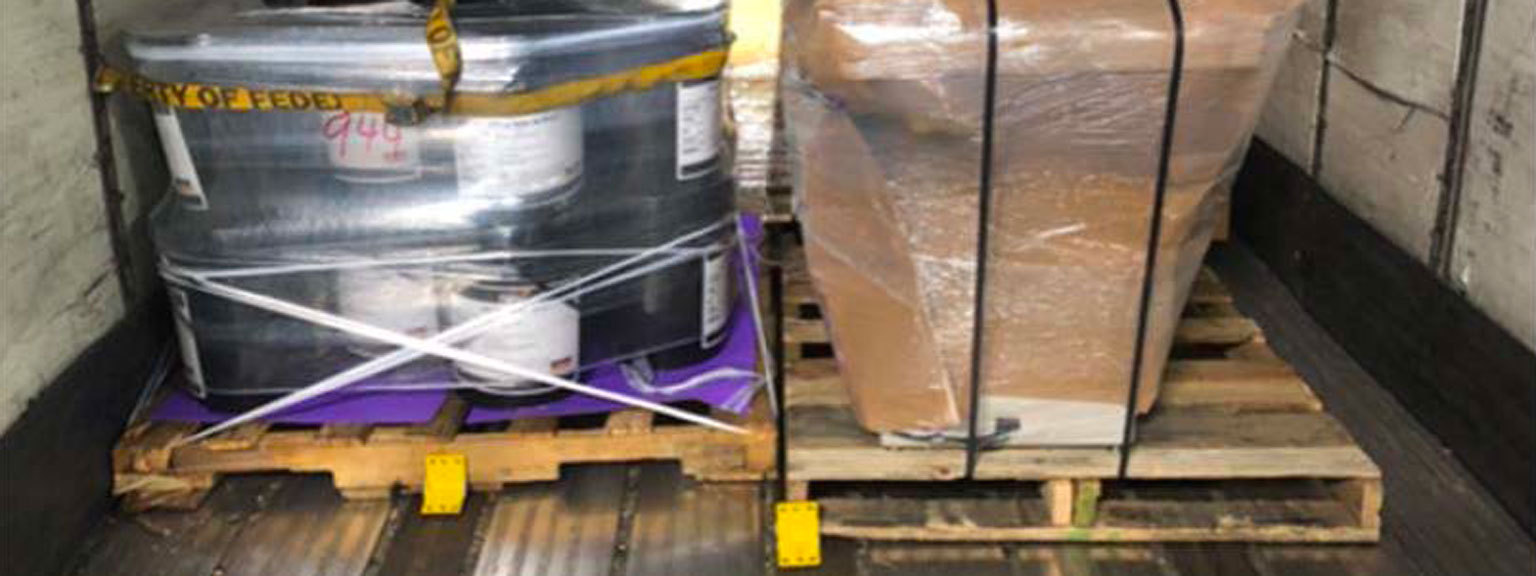
Mixed freight, different pallet sizes, weights, and product types in the same trailer, creates securement challenges that single-product loads don’t face. A method built around one uniform pallet size often breaks down when the load isn’t uniform. This article covers what actually holds up across a mixed load.
Why Mixed Freight Is Harder to Secure
Most load securement guidance assumes a uniform load: same pallet size, same weight, same product, stacked the same way throughout the trailer. Mixed freight breaks that assumption. Different pallet footprints create irregular gaps. Different weights shift at different rates under braking and cornering. A securement method that depends on uniform pressure or uniform spacing struggles when the load itself isn’t uniform.
Void-fill dunnage in particular performs inconsistently on mixed loads, since a gap sized correctly for one pallet type may be entirely wrong for the pallet next to it.
How KICK STOPS Secures Mixed Freight
KICK STOPS addresses mixed freight the same way it addresses uniform freight: by anchoring the tail-end row of pallets directly to the trailer floor and closing void space through load pattern design rather than filling gaps with material sized for one specific pallet type.
Because the device installs at the base of each pallet regardless of that pallet’s size or weight, it performs consistently across a mixed load in a way that void-fill methods, which depend on precise gap sizing, cannot. The load pattern itself, not the dunnage, is what accounts for the different pallet sizes and weights in the trailer, and KICK STOPS anchors whatever pattern is designed.
Key Takeaways
Mixed freight loads, with different pallet sizes, weights, or product types, create irregular void spaces that void-fill dunnage struggles to address consistently.
KICK STOPS anchors pallets to the trailer floor regardless of pallet size or weight, which makes it consistent across mixed loads rather than dependent on uniform gap sizing.
Load pattern design, not the securement material itself, is what accounts for different pallet types within the same trailer.
The same device and installation method used for uniform freight works for mixed freight, no separate configuration is required.
Frequently Asked Questions
What pallet restraint systems work for mixed trailer freight?
A physical floor-anchored restraint device, rather than void-fill dunnage, is more consistent across mixed trailer freight because it doesn’t depend on precisely sized gaps between uniform pallets. KICK STOPS anchors the tail-end pallet row to the trailer floor regardless of individual pallet size or weight.
Does mixed freight require a different load pattern than uniform freight?
Yes. Mixed freight typically requires a custom load pattern that accounts for the different pallet footprints and weights in the trailer, rather than a repeating uniform pattern. The securement device itself does not change, but how the load is arranged does.
Is void-fill dunnage effective on mixed pallet loads?
Void-fill dunnage is sized for a specific gap, which makes it less consistent on mixed loads where gap sizes vary by pallet. A method that anchors pallets directly to the floor is not dependent on gap size in the same way.
Can KICK STOPS handle different pallet weights in the same trailer?
Yes. KICK STOPS is tested to meet and exceed DOT minimum g-force requirements regardless of individual pallet weight within the trailer, as long as the load pattern and minimum device count are followed correctly.
Have a mixed freight lane that’s been difficult to secure consistently? We’ll build a custom load pattern for your specific mix of products and pallet types. Request a demo
KICK STOPS: The most cost-effective, time-saving, and sustainable freight securement system in the industry.