
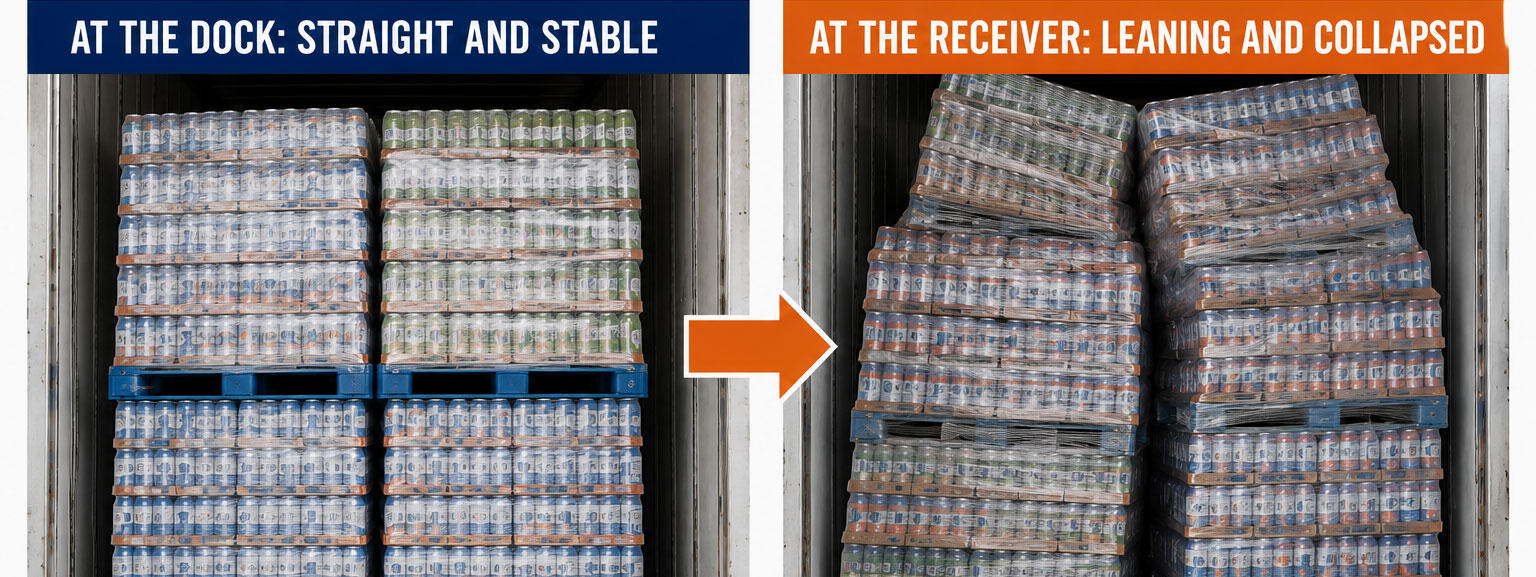
Pallet pyramiding is one of the most common types of freight damage in food and beverage distribution. It is also one of the most preventable. And it almost always starts at the loading dock, not on the road.
What Is Pallet Pyramiding?
Pallet pyramiding occurs when the product on a pallet shifts and leans to one side in transit, creating a pyramid-like shape when viewed from the front. Cases that were stacked straight and stable when the trailer left the dock arrive leaning, compressed, or collapsed at the receiver.
When the receiver opens the door, the full extent of the shift becomes apparent.
What Causes Pallet Pyramiding?
Pallet pyramiding is almost always a load design failure, not a securement failure. The most common causes are:
Gaps between pallets
When pallets are not bumped tight inside the trailer, open space exists between them. Under braking, cornering, or the vibration of a long haul, that space allows pallets to move. As one pallet shifts, it creates pressure on adjacent pallets. The result is a cascading lean that shows up at the receiver as pyramiding.
No bricking in the load pattern
Bricking means offsetting pallet rows so that the seams between pallets in one row do not align with the seams in the next row. A non-bricked load has straight lines of open space running through it front to back. Those lines are where movement starts. A bricked load closes those lines and distributes weight more evenly across the load.
Improper stacking on the pallet itself
If cases are not stacked correctly on the pallet, the pallet base may be stable while the product above it is not. Top-heavy or unevenly stacked pallets are more susceptible to pyramiding.
Long transit lanes with multiple handling points
Intermodal freight experiences more force than over-the-road freight. Rail sections introduce vibration and lateral movement over longer distances. The longer the lane and the more handling points involved, the more opportunity a poorly designed load has to shift. Pyramiding that might not occur on a short OTR lane may occur consistently on an intermodal run.
How Do You Prevent Pallet Pyramiding?
Prevention starts at the loading dock before the truck leaves. The two most important steps are:
- Bump every pallet tight. Zero gaps between pallets eliminates the space where movement starts.
- Brick the load. Offset rows so no straight lines of open space run through the load front to back.
KICK STOPS are placed at the tail end pallet. Keeping everything unitized in transit. One device, placed correctly, prevents the pallets from pyramiding on long hauls.
Why Does Pyramiding Keep Happening?
Most operations have a load pattern process on paper. The gap between what the SOP says and what actually happens on the dock is where most pyramiding originates.
When loading team members build loads differently depending on who is working, or when the SOP is not consistently enforced, the result is inconsistent load quality. Some loads arrive perfectly. Others pyramid. The variation is not random. It traces back to the dock.
Ready to eliminate in transit damage? Request a free load pattern review at kickstops.com. We come to your facility, assess your freight, and build a custom load pattern. No commitment. No sales pitch.
FAQ
What is pallet pyramiding?
Pallet pyramiding occurs when product on a pallet shifts and leans to one side in transit, creating a pyramid shape. Cases that were stacked straight when the trailer left the dock arrive leaning or collapsed at the receiver.
What causes pallet pyramiding?
The most common cause is gaps between pallets in the load pattern. When pallets are not bumped tight, open space allows movement to start under braking, lane or elevation changes. Non-bricked load patterns and improper stacking also contribute.
How do you prevent pallet pyramiding?
Bump every pallet tight so there are no gaps. Brick the load by offsetting rows so no straight lines of open space run through the load. KICK STOPS is placed at the tail end pallets keeping the whole load unitized in transit.
Does pyramiding happen more on intermodal lanes?
Yes. Intermodal freight experiences more vibration and lateral movement than over-the-road freight. The longer the lane and the more handling points involved, the more opportunity a poorly designed load has to shift. Pyramiding that might not occur on a short OTR lane may occur consistently on an intermodal run.
Is pallet pyramiding a securement failure or a load design failure?
Almost always a load design failure. Pyramiding starts in the gaps between pallets and in the absence of bricking. Cargo securement placed on top of a poorly designed load does not prevent pyramiding. The load pattern must be correct before any securement device is applied.