
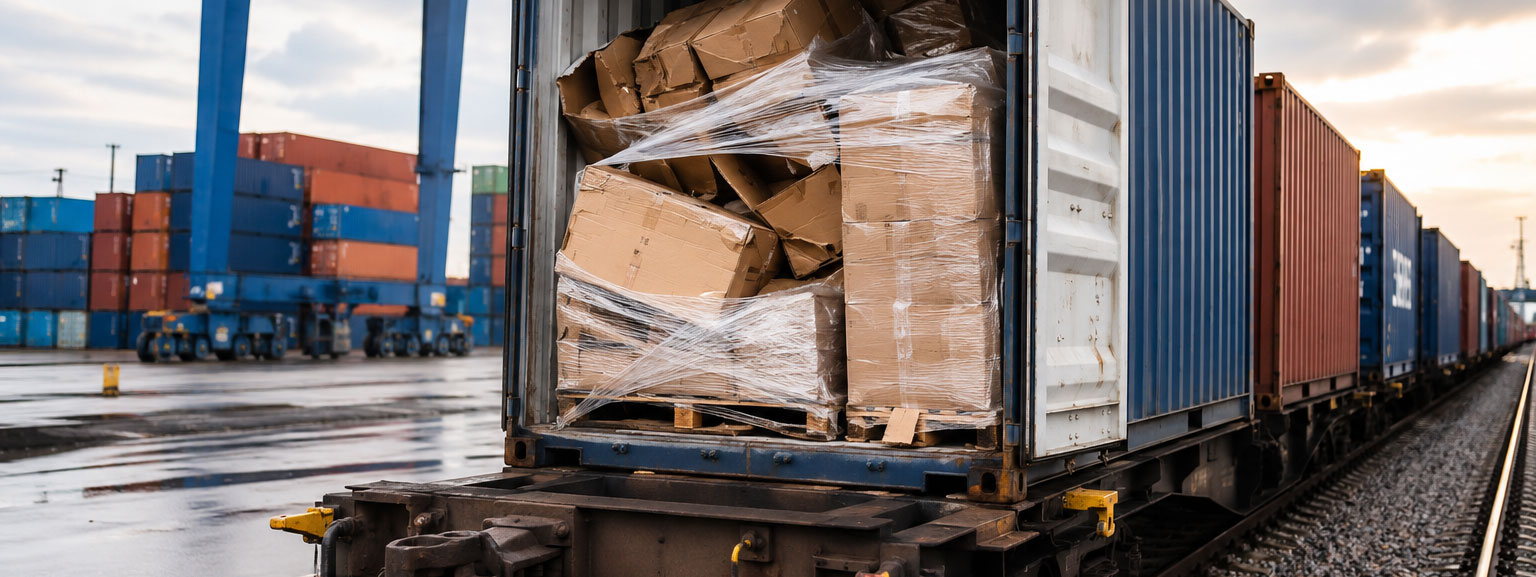
Intermodal freight lanes consistently produce higher damage rates than over-the-road lanes. Most operations know this. Fewer understand exactly why. And fewer still address the root cause at the right point in the process.
What Makes Intermodal Lanes Different?
An intermodal shipment moves on more than one mode of transportation, typically a combination of truck and rail. A load that leaves a food and beverage DC in a trailer gets lifted onto a flatcar, travels the rail portion of the lane, is lifted off and transferred to a chassis, and is then trucked to the final destination.
That process introduces forces that a standard over-the-road lane does not. More handling points. More vibration. More lateral movement. More opportunities for a load that was not built correctly to show its weaknesses.
The Forces That Act on a Load During Intermodal Transit
Rail vibration
Rail travel generates consistent vibration across the entire load. Unlike highway travel where shocks are intermittent, rail vibration is sustained across long distances. A load with gaps between pallets does not absorb that vibration. It responds to it. Pallets that are not bumped tight begin to walk incrementally over hundreds of miles.
Lateral movement during rail curves
Rail curves generate lateral g-forces that push the load toward the outer wall of the trailer. A load without proper cross-bracing or bricking is susceptible to leaning and shifting on long curved sections.
Crane and forklift handling at transfer points
At intermodal terminals, trailers are lifted by crane or moved by reach stacker. These operations generate vertical and horizontal forces that can shift a load that was already marginal. A load that survived the first truck leg may be shifted at the terminal before the rail leg even begins.
Multiple handoffs and transit times
Intermodal lanes are longer and involve more parties than OTR lanes. More time in transit means more cumulative force on the load. More parties means more variation in how the load is handled at each point.
Why the Loading Dock Is Still the Root Cause
Every one of these forces acts on what was built at the loading dock. A load with gaps between pallets and is not secure in place, is vulnerable to all of them. A load built correctly, with every pallet bumped tight and secured in place, is significantly more resilient.
The damage that shows up at the receiver on an intermodal lane did not start at the rail terminal or the chassis transfer point. It started the moment a gap was left between pallets at time of loading.
What KICK STOPS Does for Intermodal Lanes
KICK STOPS was designed specifically to address the forces intermodal freight experiences. The device is placed at the tail end of the load and grips both the pallet and the trailer floor 1/16th of an inch. They prevent movement that allows the entire load to walk forward during rail transit.
KICK STOPS are used on an intermodal lane running from Greenville, South Carolina to Redlands, California. The load arrives exactly as it was built. That lane includes both truck and rail legs. KICK STOPS holds through the entire journey.
KICK STOPS are accepted as additional securement by the AAR for intermodal and rail use.
Ready to eliminate in transit damage? Request a free load pattern review at kickstops.com. We come to your facility, assess your freight, and build a custom load pattern. No commitment. No sales pitch.
FAQ
Why does intermodal freight have higher damage rates than over-the-road freight?
Intermodal lanes introduce more forces on a load than standard OTR lanes. Rail vibration is sustained over long distances, lateral movement occurs on curves, and crane and forklift handling at transfer points adds vertical and horizontal force. More handling points and longer transit times mean more cumulative exposure to these forces.
What causes freight damage on intermodal lanes?
The root cause of intermodal freight damage is almost always the load configuration. Gaps between pallets, absence of bricking, and nothing securing the pallets in place allow the forces of rail transit to move the load. The damage shows up at the receiver but started at the loading dock.
How do you prevent freight damage on intermodal lanes?
Build the load correctly before it leaves the dock. Ensure no gaps between pallets and KICK STOPS placed at the tail end of the load keeping it unitized in transit.
Is KICK STOPS approved for intermodal and rail use?
KICK STOPS are accepted as additional securement by the AAR for intermodal and rail use.
What is the most common point where intermodal freight damage originates?
The loading dock at the origin facility. Gaps between pallets and poorly designed load patterns are the conditions that allow intermodal forces to cause damage. Fixing the load configuration first is the most effective way to reduce intermodal damage rates.